AI upskilling for automotive R&D, taught by an engineer who ships
AutoMotivate, EmbedAI's AI upskilling practice for automotive R&D, turns GenAI awareness into hands-on capability for engineers who build ECUs and vehicle software, not generic office workflows.
The problem
Automotive R&D is under an adoption mandate its training market has not caught up with. The courses on offer are built around office workflows, so an engineer leaves a day of them with nothing that touches an ECU log or a test case. What a Tier-1 or OEM team needs is GenAI inside its own kind of work.
What the portfolio proves
Designing and running role-relevant AI upskilling for engineering organisations, grounded in 25+ years in software, embedded systems and automotive engineering. The AutoMotivate workshop proves it end to end: an 11-module, 22-live-demo two-day build covering GenAI-assisted coding, ECU log analysis, agentic workflows and PII-safe automation, all on synthetic automotive data for a fictional company.
How the projects fit together
The AutoMotivate workshop is the one carded build behind this practice — a complete delivery kit an engineer can run in two days. It is a Prototype: the core works end to end and can be demonstrated; it is not production-hardened or generally available. The manufacturing consulting work sits here as secondary evidence. It is In use — running today and in regular use; it is not an open public service you can sign up for, and it carries no public product name of its own. The engagement ladder it sells — diagnostic, then pilot, then capability build — is the same one the workshop teaches. Together they show a practice that teaches what it also does.
What I can do here
This is the practice the Services page describes in full: keynotes, hands-on bootcamps, mentored pilots and capability assessments, sized to the team and the timeline rather than sold as a fixed package.
How mature this is
One carded project sits behind this practice, and it is a Prototype: built and delivery-ready, but not yet a long public record. The commissioning client stays an automotive R&D training client until named.
Mapped projects
AutoMotivate workshop
Prototype
The core works end to end and can be demonstrated; it is not production-hardened or generally available.
A delivery-ready two-day GenAI workshop build for automotive R&D teams, and the one carded build behind AutoMotivate, EmbedAI's AI upskilling practice for automotive R&D.
Automotive engineering teams are told to adopt AI, then handed a generic course built for office workflows, not their own kind of work.
An 11-module, 22-live-demo executive workshop with a full delivery kit (run-of-show, preflight checklist, governance pack) covering GenAI-assisted coding, ECU log analysis, agentic workflows and PII-safe automation, all on synthetic automotive data for a fictional company.
Built on LangGraph and CrewAI for the agentic-workflow modules, with a PowerShell workshop runner orchestrating the demo scripts.
15 or more synthetic automotive artefacts are all authored for a fictional company, so the demo content itself is safe to describe in full.
PowerShell workshop runner
Python demo scripts
LangGraph
CrewAI
Capabilities
In use
Running today and in regular use; it is not an open public service you can sign up for.
Two client-proposal demos for manufacturing clients: a design-for-X (DFX) knowledge platform, and an AOI-window defect classifier.
Manufacturing and EMS clients need to see and pilot practical AI — design-rule capture, defect classification — before committing to a larger engagement; a slide deck does not answer that, a working demo does.
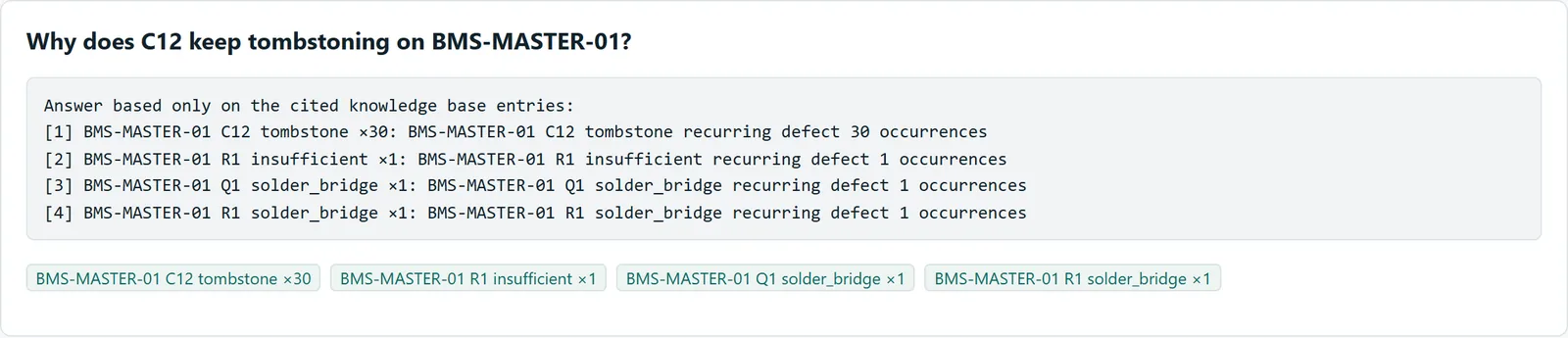
The DFX platform runs a design-rule engine and a Q&A feature that answers only from cited sources (it visibly declines to answer outside that scope). The AOI-window classifier is a CPU-based defect classifier that sorts inspection-window images into defect classes with a confidence score. Both are paired with proposal decks generated from code.
The Q&A feature's citation-or-refusal behaviour is the notable engineering point: it is built to say "outside my sources" rather than guess, backed by 10 passing tests.
The classifier runs on CPU (ONNX/torch), not dedicated inference hardware, which matters for a client who does not want to add a GPU to a line, backed by 65 passing tests.