Applied AI that fits behind equipment a plant already owns
Two client-facing demos — a design-rule knowledge platform and a CPU-only defect classifier — show how AI slots into a manufacturing line without asking the client to rip anything out.
The problem
Manufacturing and EMS clients need to see and trial practical AI — capturing design rules as answerable knowledge, running defect classification behind an inspection step already on the line — before they commit to a larger engagement. A slide deck does not answer that; a working demo does.
What the portfolio proves
Building and demonstrating client-facing manufacturing AI: a design-for-X (DFX) knowledge platform whose Q&A feature answers only from cited sources, and an AOI-window defect classifier that runs on CPU rather than needing dedicated inference hardware. The interiors cut-list engine adds manufacturing-spec accuracy as secondary evidence from a different industry.
How the projects fit together
The manufacturing consulting work (In use, no public product name of its own) carries both demos: the DFX platform (10 passing tests) and the AOI-window classifier (65 passing tests). They were built for an EMS manufacturer and a business-process services firm. WoodTech Interior Design (Prototype) sits here as secondary evidence: its cut-list engine holds a manufacturing tolerance (0.5 mm against golden files) that is the same discipline in a different industry.
What I can do here
This vertical is the clearest fit for the diagnostic-sprint-then-pilot engagement shape on the Services page: a short scoping conversation, then a demo built against the client's own constraint.
How mature this is
These are client-proposal demos, not deployed production lines, and the copy must say so. Client identities stay behind neutral descriptors until the owner confirms them.
Mapped projects
Capabilities
In use
Running today and in regular use; it is not an open public service you can sign up for.
Two client-proposal demos for manufacturing clients: a design-for-X (DFX) knowledge platform, and an AOI-window defect classifier.
Manufacturing and EMS clients need to see and pilot practical AI — design-rule capture, defect classification — before committing to a larger engagement; a slide deck does not answer that, a working demo does.
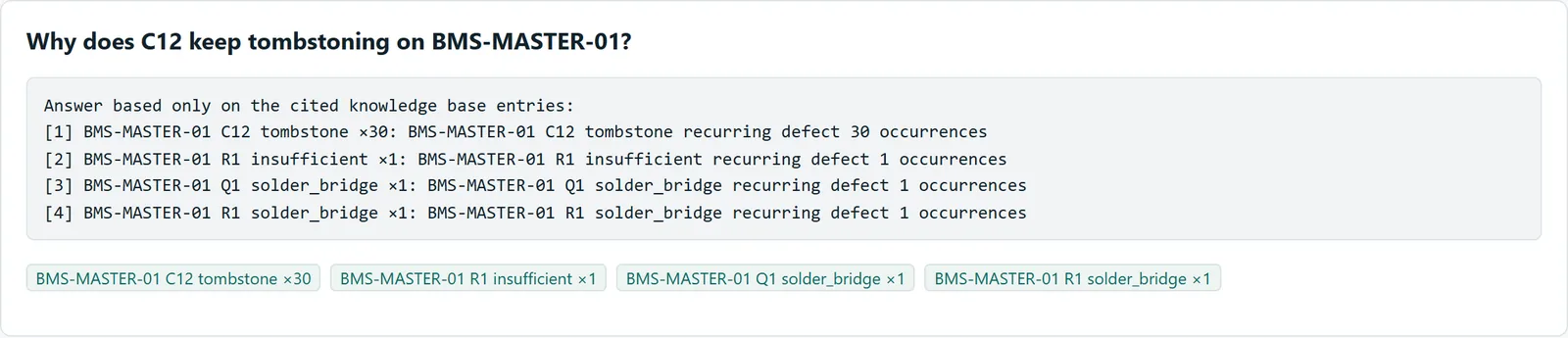
The DFX platform runs a design-rule engine and a Q&A feature that answers only from cited sources (it visibly declines to answer outside that scope). The AOI-window classifier is a CPU-based defect classifier that sorts inspection-window images into defect classes with a confidence score. Both are paired with proposal decks generated from code.
The Q&A feature's citation-or-refusal behaviour is the notable engineering point: it is built to say "outside my sources" rather than guess, backed by 10 passing tests.
The classifier runs on CPU (ONNX/torch), not dedicated inference hardware, which matters for a client who does not want to add a GPU to a line, backed by 65 passing tests.
FastAPI backend
SQLite full-text search
a CPU-based ONNX/torch classifier
Node.js generated proposal decks
WoodTech Interior Design
Prototype
The core works end to end and can be demonstrated; it is not production-hardened or generally available.
Turns a furniture idea into an exact cut-list, bill of materials and cost, with live 3D and AR.
Going from "I want a wardrobe like this" to an exact, buildable manufacturing spec and price is normally a slow back-and-forth with a carpenter.
Lets a user configure a wardrobe, TV unit or kitchen, then generates an exact panel cut-list, bill of materials, cost estimate and a live 3D view. It can turn a floor plan into whole-house cabinetry. A chat assistant and an Android AR app place the design at true scale.
Automated cut-list tests pass against golden files within 0.5 mm tolerance — the kind of accuracy claim a manufacturing-minded peer checks first.